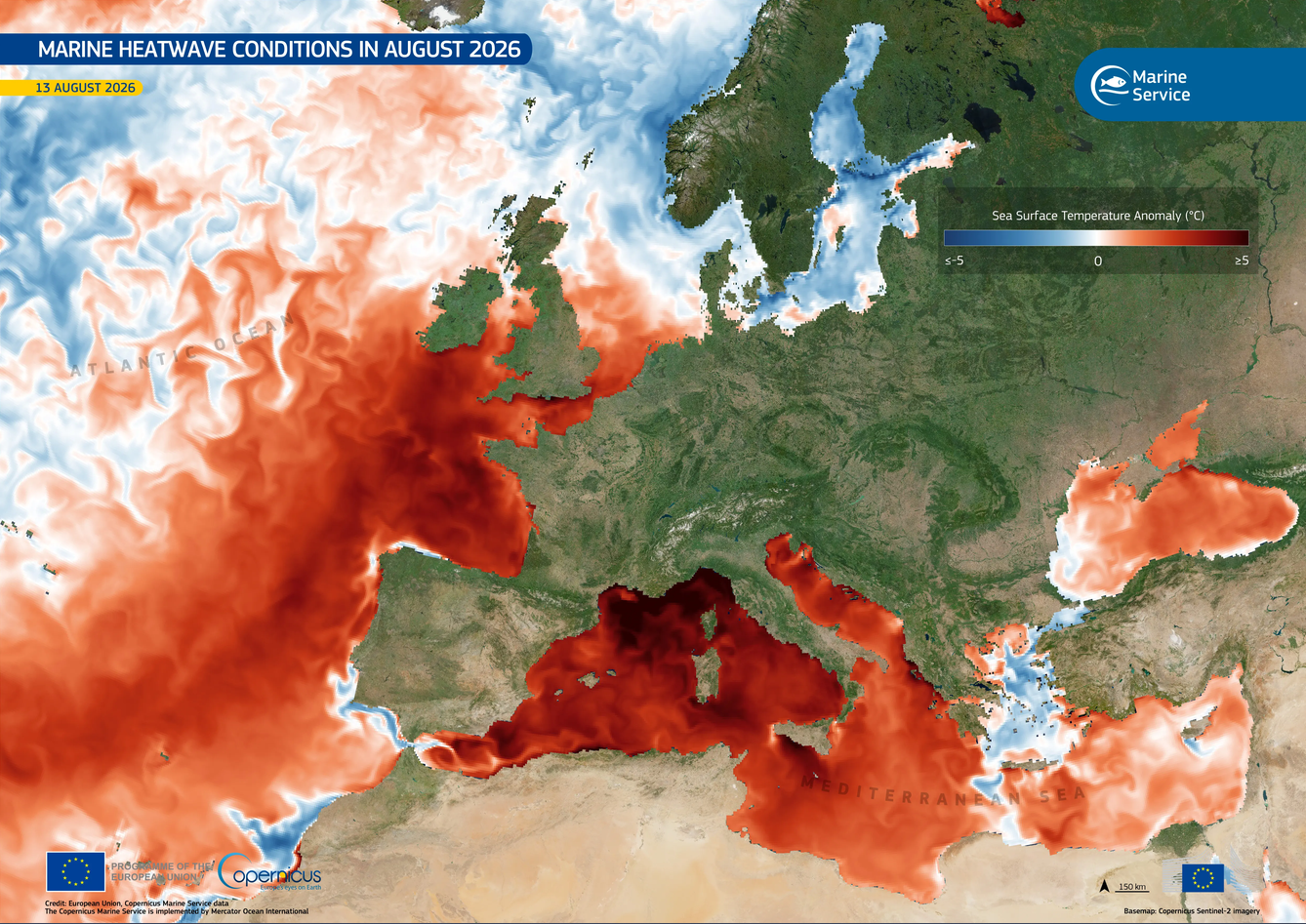
Key Data and Temperature Benchmarks
- Hottest July on Record: The average surface temperature across the entire Mediterranean basin reached 27.07°C in July 2026, the highest ever documented for that month.
- Extreme Local Peaks: In early August 2026, an offshore buoy near Mallorca, Spain recorded a staggering sea surface temperature of 33°C.
- Massive Thermal Anomalies: The western Mediterranean bore the brunt of the early summer surge. In areas like the Gulf of Lion off southern France and the Ligurian Sea near Italy, temperatures spiked up to 6°C to 8°C above long-term averages.
- Widespread Coverage: Marine heatwaves have blanketed virtually the entire basin, with 95% to 98% of the Mediterranean Sea registering above-average sea surface temperatures during the season.
Why Is It Overheating So Fast?
The Mediterranean is often described by climate scientists as a climate change “hotspot” because it is warming at twice the rate of the global ocean average. Its physical characteristics worsen the situation: it is a mostly closed, relatively shallow body of water with minimal exchange with the cooler Atlantic Ocean. During the summer of 2026, relentless atmospheric “heat domes” and blocking high-pressure systems over southern Europe continuously transferred intense thermal energy directly into the sea.
The Aegean anomaly
While the western and central Mediterranean regions reached historic, furnace-like conditions this summer, parts of the Aegean Sea stood out as a noticeable cooler anomaly. Data maps from the Copernicus Marine Service clearly highlighted cooler-than-average ocean pockets localized directly in the Aegean basin. [1]
Oceanographers and meteorologists point to two main regional phenomena to explain this anomaly:
1. The Meltemi Winds (The “Etesians”)
The single biggest factor keeping the Aegean Sea cooler is a powerful, seasonal atmospheric engine called the Meltemi winds.
- How it works: During July and August, a sharp pressure gradient develops between a persistent high-pressure system over the Balkans and a deep thermal low-pressure system over Turkey and South Asia.
- The 2026 Impact: This summer, the Meltemi blew relentlessly across the Aegean, with gusts frequently exceeding 90–100 km/h in mid-August (notably slamming islands like Tinos and Paros). These strong, dry, and relatively cooler northerly winds continuously sweep across the sea surface, acting like a giant fan that disrupts the extreme heat building up elsewhere in the Mediterranean.
2. The Oceanographic Process of “Upwelling”
The sheer mechanical force of the Meltemi winds triggers a crucial marine process known as coastal upwelling.
- As the northerly winds blow forcefully across the open corridor of the Aegean, they push the sun-warmed, buoyant surface waters southward.
- To replace this displaced surface water, chilled, nutrient-rich water from the deep ocean floor is dragged up to the surface.
- This continuous vertical churning acts as a natural air conditioner for the sea, actively suppressing sea surface temperatures and preventing the formation of a static marine heat dome like the one that superheated Mallorca or the Gulf of Lion.
Summary of the Mediterranean Thermal Divide
While the western Mediterranean sat under a stagnant, highly stable atmospheric “heat dome” that allowed the sea to bake uninterrupted, the Aegean was under constant, aggressive atmospheric and hydrodynamic circulation.
